How a Wise Woman in Ibadan Helped Me Stop Tying My Value to Who Chooses Me — And Finally Feel Whole on My Own

If you are constantly waiting for someone to text back before you feel okay — read every word on this page.
If you have replayed a conversation in your head a hundred times, wondering what you said wrong.
If you smile too wide when someone shows you attention. If you shrink when they pull away.
If the thought of being alone — truly alone, with no one choosing you — makes something tighten in your chest.
This page was written for you.
Not for the version of you that pretends she is fine. For the real one. The one who checks her phone at 2am. The one who stays in situations that hurt her because leaving feels like proof that she was never worth staying for.
You have tried affirmations. You wrote them on your mirror. "I am enough. I am worthy. I am loved." You said them every morning. And then someone did not call back and you fell apart anyway.
You have watched the videos. The motivational content. The "love yourself first" reels. You nodded along. You shared them. You did not change.
You have jumped into new relationships — not because you were ready, but because being chosen made you feel real again. And when those ended, the emptiness was worse than before.
You have prayed. You have kept busy. You have called your friends to fill the silence. And still — still — the moment things go quiet, that old feeling comes back.
The feeling that your value depends on someone else's decision about you.
Here is the truth nobody is saying out loud.
The problem is not that you are too needy. The problem is not that you love too hard. The problem is not even that you are afraid of being alone.
The problem is where you have put your anchor.
You have tied your worth to something that can move. Something that can leave. Something that can choose someone else on any given Tuesday — and take your sense of self with it when it goes.
And the deepest pain is not the loneliness. It is what the loneliness tells you. That you are not enough. That there is something wrong with you. That you will always need someone to confirm you are real.
That is what I want to talk about today.
I know. Because I carried it too.
My name is BlueSky Ocean.
I am not a therapist. Not a life coach with a certificate on the wall. I am just a woman who spent years inside this exact problem — looking for herself in other people's eyes and never quite finding what she needed there.

I grew up in Lagos. I was the girl who was always described as warm, generous, attentive. What nobody said — what I did not understand until much later — was that I was attentive because I was afraid. Afraid that if I stopped performing, people would leave. Afraid that if I stopped being useful, I would stop being loved.
I carried this into my relationships. Every one of them. I was the woman who texted first. Who apologised first, even when I was not wrong. Who made herself smaller when a man seemed uncomfortable with how much space she needed.
I remember sitting in my car outside a restaurant once, crying, because a man I had been seeing for three months had not responded to my message in four hours. Four hours. And I was in pieces.
That was the moment I knew something was broken. Not in him. In me.
I spent years and serious money trying to fix it. Therapy — which helped some things but not this. Books — which gave me language for the problem but not a way out of it. Self-help programmes. Journaling. Retreats. All of it.
Every time I felt like I was making progress, someone would pull away — a friend, a partner, even a colleague — and I would crash back to the beginning. The validation I had built up would dissolve like it was never there.
The doctors, the therapists, the coaches — they kept asking what happened? They wanted to trace it to a childhood wound, a specific event, a pattern they could name. But none of them asked the real question.
None of them asked: Where have you put your anchor?
Because that is what this is, really. Not a wound to heal. A placement to change.
I did not understand that until I went home to Ibadan.
It was a family gathering. One of those gatherings that Yoruba families do not plan so much as simply allow — word spreads, people show up, someone brings food, someone brings music, and by afternoon the compound is full.
In Ibadan, these gatherings carry something you do not find in cities like Lagos anymore. A slower quality. An older way of being. The women sit together in the shade and they talk the way women used to talk — not performing, not curating, just saying the real thing.
I was sitting in a circle of women I had known my whole life. One was married. One had recently divorced. One was engaged. One had been single for years. All different situations. All different seasons of life.
And yet as the conversation went on, I noticed something strange.
They were all saying the same thing.
The married woman was afraid her husband would leave. The divorced woman felt like the divorce had confirmed something she had always feared about herself. The engaged woman was already anxious — what if he changes his mind? The single woman had convinced herself that being unchosen meant she was unchooosable.
Different situations. Identical fear.
The fear of not being chosen. And what that says about your worth.
I sat quietly and listened. And something in me went very still. Because I recognised every word of it. I could have said every one of those sentences myself.
There was an older woman in the corner of the compound. Mama Folake. She had said almost nothing all afternoon. She was watching us. And at some point, her eyes met mine — and I saw it. Recognition. And concern.
I looked away quickly. I felt, suddenly, completely seen. And not in a comfortable way.
I have never been more ashamed in my life.
The Discovery That Changed Everything
Later, when the gathering had thinned and people were beginning to drift home, Mama Folake found me near the kitchen. She did not sit down dramatically. She did not make a speech. She just stood beside me and was quiet for a moment.
Then she said five words.
"You are not broken, my daughter."
I did not cry right away. I stood there. And then something in my chest — something I had been holding rigid for years — gave way. And I wept. Not the neat, careful kind of crying. The kind that comes from somewhere deep.
She waited until I was done. Then she sat down across from me and she spoke.
Your worth has a natural anchor point. When that anchor is placed correctly — inside yourself — it holds, regardless of weather. Regardless of who comes and goes.
But somewhere along the way, most of us were taught — by family, by culture, by love stories, by the way marriage is spoken about — that our value as women is confirmed by whether we are chosen. By whether we are kept. By whether someone decides we are worth staying for.
So we move the anchor. We put it outside ourselves. And then we live in constant fear of the waves — because our stability now depends on things we cannot control.
The affirmations do not work because they are applied to the surface. The real work is relocating the anchor. Moving it back to where it belongs. Inside you. Fixed. Immovable. Not dependent on anyone's decision about you.
I sat with that for a long time.
I thought about all the money I had spent. All the times I had rebuilt myself after a relationship ended — only to discover I had rebuilt myself around the new person too. I had not fixed anything. I had just transferred the anchor to a different boat.
It took one woman, in a quiet compound in Ibadan, to tell me what was actually happening.
What Mama Folake shared was not complicated. It was not a meditation retreat. It was not years of therapy. It was a practical, methodical process — something you do in a few focused minutes each day — that systematically moves your sense of worth back to an internal foundation.
No performing. No convincing yourself. No forcing feelings that are not there. A gentle, structured process that works with the way your nervous system actually learns — through repetition, through embodiment, through gentle confrontation of the pattern itself.
Done at home. Takes less than five minutes a day. No special equipment. No external validation required.
The First Few Days: Nothing
Day 1. I did the process. It felt slightly awkward. Like stretching a muscle I did not know I had.
Day 2. I went back to old habits. Checked my phone too much. Felt the familiar pull when a friend did not respond quickly.
Day 3. I almost stopped. I thought: this is not working. The doubt was loud.
Day 4. I remembered what Mama Folake said. Do not rush it. Do not skip the quiet parts. I stayed with the process.
Day 5: The First Sign
Something small shifted.
A man I had been speaking to went quiet for two days. The old me would have spiralled. Replayed our last conversation. Drafted and deleted messages. Catastrophised.
Instead — and I noticed this almost by accident — I thought about it for a moment. And then I made myself a cup of tea and opened a book.
Not because I was suppressing the feeling. But because the feeling was simply... smaller. Less urgent. Less like a verdict.
I did not quite trust it yet. But something was different.
Day 6. Day 7. Then Something Broke Open.
By Day 8, I noticed I was enjoying my own company in a way I had not in years. I sat with myself and it was not uncomfortable. It was not something to fill. It was just — quiet. And okay.
By Day 10, a friend cancelled plans on me with a short, dismissive message. Six months ago, that would have ruined my week. I was disappointed — I allowed that — and then I made other plans. For myself. And I enjoyed them.
But the moment that still gets me — even now — was Day 12.
I realised, at noon, that I had not yet checked if anyone had messaged me that morning. I had woken up, made coffee, sat with my thoughts, gone for a short walk — and it had not occurred to me to reach for my phone to confirm that I was okay.
I had been doing that every single morning for years. Every single morning. Checking for evidence that I was still chosen. Still valued. Still real.
And that morning, I forgot.
I forgot to check if I was worth something. Because somewhere in those twelve days, I had stopped needing external confirmation to answer that question.
But the real test was yet to come.
Friday Night
There is someone in my life. We had been rebuilding something, carefully, after months of distance that I had partly caused with my own anxiety and need for reassurance.
On a Friday evening, he reached for my hand across the table. Not dramatically. Just — reached for it.
The old me would have gripped it too tight. Would have felt a rush of relief — he still wants me — and read enormous meaning into a simple gesture. Would have spent the rest of the evening managing his mood, watching his face for signs.
Instead, I held his hand. Warmly. Calmly. Present. Not desperate. Not performing. Not conducting surveillance on his emotions to determine my own value.
Just — there. With him. As myself. Not as a woman auditioning to be kept.
Later that evening, I cried. Not from shame. Not from relief. From something quieter and harder to name. Like meeting yourself after a long time away.
He said afterward that something felt different. That I seemed settled. That he had not realised how much he had missed this version of me — the one that was not always bracing for him to leave.
I understood, then, what Mama Folake had meant when she said the anchor changes everything. Not just how you feel about yourself. How you show up in every room you enter.
I Didn't Plan to Tell Anyone
I told one friend. Adaeze. We had been close since university. She had watched me go through all of it — the spiral, the dependency, the rebuilding — from a polite, careful distance, because she was carrying the same thing herself and had never admitted it.
When I told her what had changed, she went quiet for a long time. Then she asked me to explain the whole process.
Within two weeks, she had shared it with three other women. Voice notes on WhatsApp. "You need to see this. Trust me." Women who had never spoken this particular truth out loud suddenly had a name for it — and a way out.
Same ritual. Same framework. Same results.
"I have been in therapy for two years. I love my therapist. But I could never explain why I kept collapsing after relationships ended even when I knew, intellectually, I was going to be okay. This framework named something my therapy never did. The anchor metaphor alone was worth everything. Three weeks in and I stopped needing my ex to respond to move on with my day. That was not possible before."
"I used to send my friends voice notes at midnight begging for reassurance that I was not too much. I would analyse every conversation I had with a man for hours. I am not that person anymore. I finished the framework in ten days. Something shifted in my chest. I feel like I finally live inside myself."
"After my divorce, I convinced myself I was undateable. That the divorce was proof of something fundamentally wrong with me. I was about to enter a situationship I knew was bad because I needed the attention. I downloaded this guide the night before I was supposed to agree to it. I did not agree to it. Worth Anchor™ gave me the reason to choose myself instead."
"I am engaged now and I still needed this. I did not realise how much of my self-worth was wrapped in the relationship until my fiancé went on a work trip and I fell apart for five days. This framework helped me understand that even in a good relationship, I had anchored my okayness to his presence. I am better for him now because I am better for myself first."
"I thought self-worth was about confidence. I was confident. I could walk into a room. I could speak up. But the moment a man did not choose me, confidence disappeared. This guide taught me the difference between surface confidence and anchored worth. That difference changed my life."
"I had tied my worth so tightly to being a wife and mother that when my marriage had problems, I completely lost myself. I forgot who I was without the role. The Worth Anchor Framework helped me find her again. She was always there. I had just built over her with other people's definitions of my value."
Same ritual. Same framework. Same method. Same results.
Why I Am Sharing This
I went back to Ibadan. I found Mama Folake. I told her what had happened — with me, with Adaeze, with the women the voice notes had reached.
She laughed. The deep, unhurried kind of laugh that older Yoruba women have — like they have seen enough of life to know that everything comes around eventually.
I asked her if I could document it. Write it down. Make it available to women who would never get to sit in a compound in Ibadan on an afternoon and have it land in their laps the way it had landed in mine.
She was quiet for a moment.
This guide is my attempt to honour that instruction.
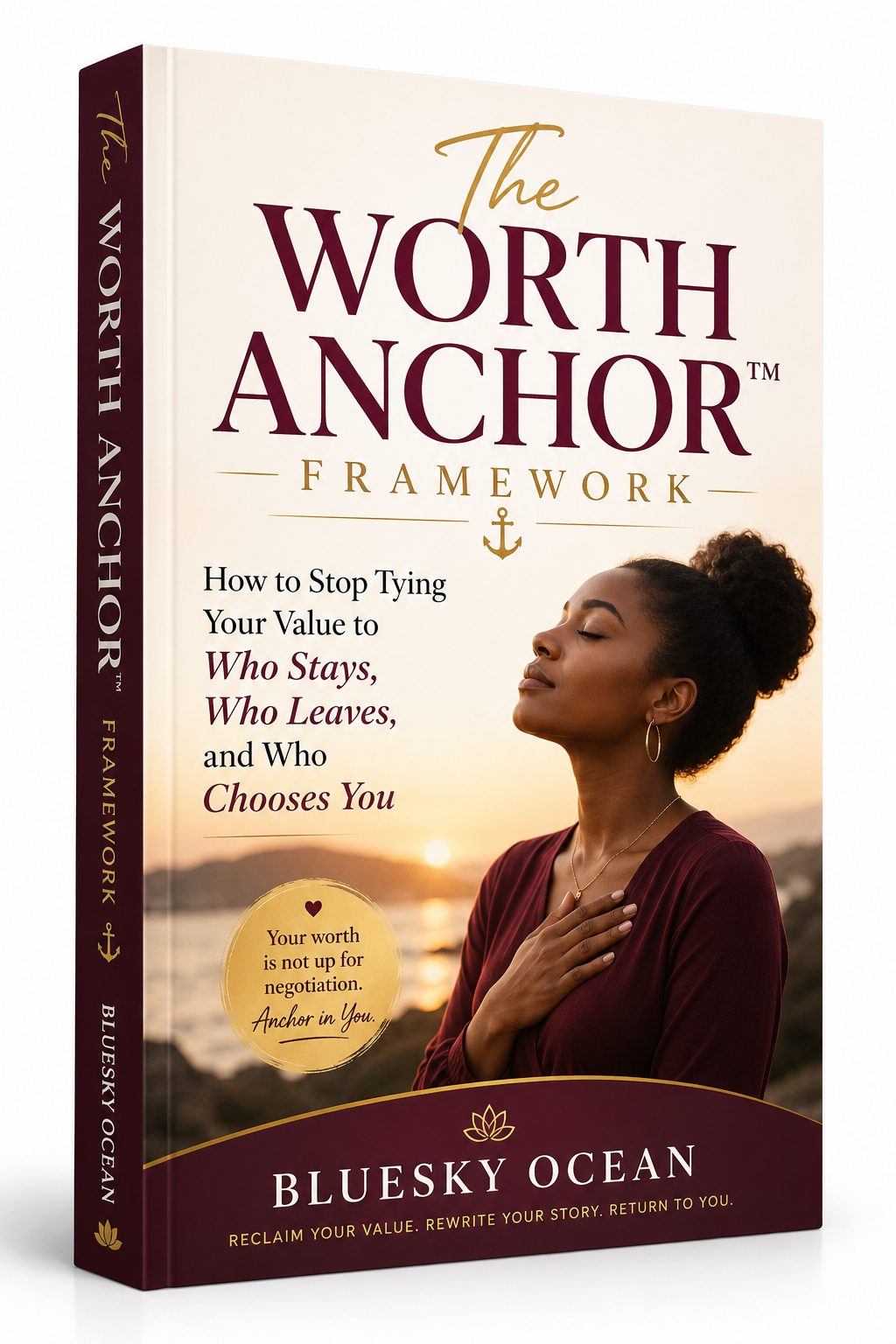
Everything Mama Folake taught me — documented, verified, written in plain language, so you can begin tonight. No special equipment. No long programme. No performing emotions you do not feel yet. Just a clear, practical process for moving your worth back where it belongs.
- The Real Reason You Keep Holding On — Why the fear of being alone is rarely about being alone. You'll discover the exact belief driving your overthinking, your need for reassurance, and the way rejection hits you harder than it should. This chapter names what most women have never had named. (Chapter 1)
- The Invisible Debt You're Paying Every Day — The hidden price of tying your worth to other people's behaviour — how it drains your energy, shapes your decisions, and quietly costs you opportunities, confidence, and peace. Includes the five signs your worth is currently anchored in the wrong place. (Chapter 2)
- The Three Places Women Most Commonly Anchor Their Worth — Approval, achievement, and relationships. You'll identify exactly which one is pulling your confidence up and down — and why none of them were ever designed to carry that weight. (Chapter 3)
- The Ownership Shift — Taking Back the Keys to Your Happiness — The first major practical step in the Worth Anchor™ Framework. How to stop allowing other people's attention, silence, or behaviour to decide how you feel about yourself — including a seven-day daily ownership challenge. (Chapter 4)
- The Loneliness Lie That Keeps Women Stuck — The critical difference between loneliness and solitude, why silence feels so uncomfortable, and a four-week Solitude Training Plan that teaches you to genuinely enjoy your own company — without pretending or forcing it. (Chapter 5)
- The Relationship Mirror — Seeing People Clearly When Fear Is Removed — How fear distorts the way you see partners, why being chosen starts feeling more important than compatibility, and a five-question relationship filter that can save you years of heartache. (Chapter 6)
- Becoming the Woman Who Doesn't Chase — What emotional chasing actually looks like (it's rarely what you think), the Validation Fast exercise, the habits of emotionally secure women, and your personal Worth Anchor™ identity statement to read daily. (Chapter 7)
- Your 30-Day Worth Anchor Reset Plan — A complete week-by-week roadmap: Week 1 builds awareness with the Trigger Tracker and daily silence practice. Week 2 moves the anchor inward. Week 3 builds emotional independence. Week 4 is full integration — plus an emergency plan for the hard days when old fears return. (Chapter 8)
You do not need to travel anywhere. You do not need to see anyone. Everything in this guide can be done in your own home, in your own time. Total cost of materials? Nothing. You already have everything you need.
Compare That to What You Have Already Been Spending
Valuable, but most therapy addresses symptoms and past events, not the specific mechanism of worth displacement. You can do years of therapy and never have this named.
Most teach you what the problem is. Very few give you a practical daily process for actually changing the pattern in your nervous system.
You feel inspired for days. Then life resumes and the pattern returns. Because inspiration without process does not hold.
Using new relationships as the solution to the wound that relationships expose. This never works. It just transfers the anchor to a new location.
None of these address the root mechanism. They are water on the leaves. The root is still dry.
The relationships you stayed in too long. The ones you left before they could leave you. The version of yourself you performed instead of the one you actually are. The mornings spent in anxiety about someone's approval instead of in your own quiet, settled life. How much has that cost you?
How Much Does This Guide Cost?
Before I tell you the price, let me show you what went into creating it.
- Research, reflection, and documentation of the method ₦120,000
- Professional writing and structuring ₦85,000
- Review and validation with women across multiple cities ₦40,000
- Design and formatting of the PDF guide ₦35,000
- Platform setup and delivery system ₦20,000
- Total investment ₦300,000+
A fair price would be ₦15,000. And frankly, for what this guide does — for the time and money and emotional cost it replaces — even ₦15,000 is extraordinarily reasonable.
But I know times are hard. I know that ₦15,000 is not a small amount. And I know that the women who need this most are often the ones who have already spent the most trying to fix it with things that did not work.
So if you take action today —
Once You Click That Button, Here Is What Happens
- You are taken to the payment page. Secure, simple, takes less than two minutes.
- You complete your payment. Card, bank transfer, or mobile payment — whichever works for you.
- Your guide is delivered to your WhatsApp AND your email within 60–90 seconds. You can begin tonight.
It is me, BlueSky Ocean. As long as your payment is confirmed, your access is 100% guaranteed.
What Happens In The First 7–14 Days
Real conversations. Real women. Real results.
What You Are Getting Today
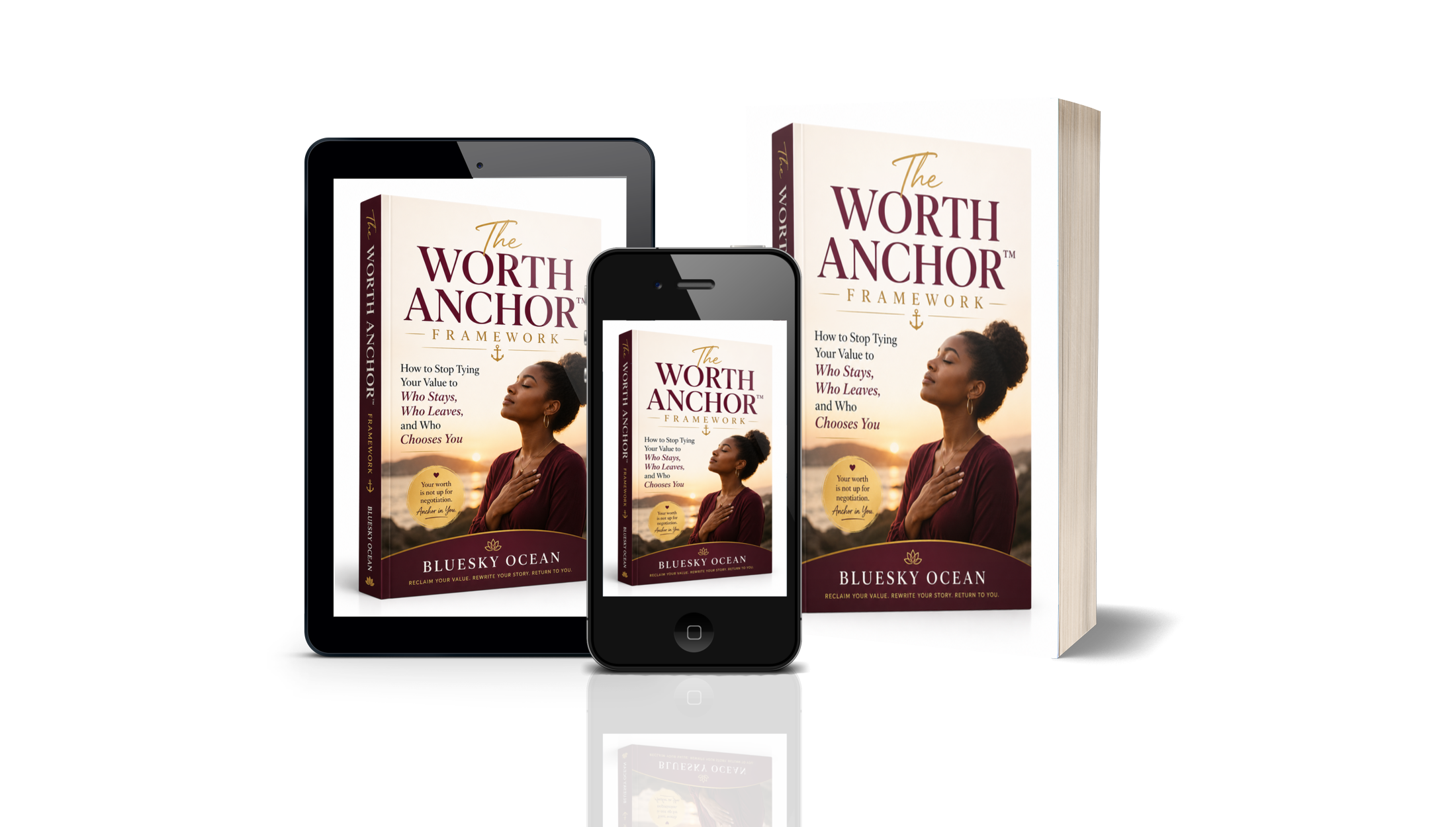
- The Worth Anchor™ Framework — Full 8-Chapter Guide
₦15,000 - The 30-Day Worth Anchor Reset Plan (Chapter 8)
- The Trigger Tracker, Ownership Challenge & Validation Fast Exercises
- The 4-Week Solitude Training Plan
- The Relationship Audit & 5-Question Clarity Filter
- Your Daily Worth Anchor Checklist & Emergency Reset Process
Right Now, You Have Two Choices
If You Do Nothing
- The next message that goes unread will feel like a verdict.
- You will keep reaching for people to confirm you are okay.
- New relationships will become the solution to the wound that relationships expose.
- You will keep performing the version of yourself that you think people will stay for.
- The settled, quiet, unshakeable version of you will remain just out of reach.
If You Get The Guide
- You begin relocating your worth to a place that cannot be taken from you.
- You show up in relationships from a place of choice, not desperation.
- You enjoy your own company. Truly. Without needing to fill the silence.
- Rejection stops feeling like a verdict and starts feeling like information.
- You become the kind of woman who chooses herself first — and attracts people worthy of that choice.
🛡 30-Day Money-Back Guarantee
Follow the Worth Anchor™ Framework exactly as written for 30 days. If you do not notice a meaningful shift in how you relate to your own worth — if you do not feel the difference in your body when you choose yourself over approval — send me a message and I will refund you in full. No questions. No guilt. No runaround. Your trust matters more to me than ₦5,000.
One Last Thing…
Picture yourself one month from today.
Will you wake up and reach, reflexively, for your phone — to check if someone has confirmed you are still okay?
Will you spend another month managing your feelings around people's behaviour, reading their silences, shrinking and performing and hoping to be chosen?
Will you look back at this moment — this exact moment — and remember it as the day you saw the door and walked away?
Or will you be that woman one month from today. The one who knows where her anchor lives. The one who walks into rooms as herself, not as a performance. The one who can be alone without falling apart. The one who, when someone reaches for her hand, holds it calmly — not desperately — because her okayness does not depend on whether they hold it back.
Now picture yourself one month from today if you close this page. Everything stays the same. The pattern continues. The next person who pulls away will pull something from you with them. And you will wonder, again, what you did wrong.
The difference between those two versions of you is a decision you make in the next sixty seconds.
I Choose the Second Version — Get The GuideIf you have read this far and you are still hesitating —
Ask yourself something honestly.
Is it really about the money? Or is it that somewhere, deep down, you are not sure you deserve to feel this way? Not sure it will work for you specifically? Not sure you are worth the investment?
Notice that. That hesitation is the problem. That is the displaced anchor making its argument. Do not spend money on yourself. What if it does not work? What if you are the exception? What if you are not worth it?
If you cannot invest ₦5,000 in permanently relocating your own worth, how do you expect the people in your life to invest in you?
You cannot pour from a position you have abandoned.
Stop hesitating. Choose yourself.
Yes — I Am Worth This InvestmentP.S. — Remember: you are protected by a full 30-day money-back guarantee. Follow the process, give it the time it asks for, and if you do not feel the shift — your money comes back. There is no risk here except the risk of not trying.
P.P.S. — This ₦5,000 price is only for the first 50 women today. Once those slots are gone, the price returns to ₦15,000. If you are reading this, the offer is still active — but I cannot promise for how long.
P.P.P.S. — Every day you wait is another day your worth stays anchored to something that can be taken from you. Every day you wait is another morning you reach for your phone before you reach for yourself. This does not have to be your life.
Frequently Asked Questions
How is the guide delivered after I pay?
Immediately after your payment is confirmed, the guide is sent to your WhatsApp number and your email address — usually within 60 to 90 seconds. You do not need to create an account or log into anything. It arrives as a PDF you can read on your phone, tablet, or computer.
Do I need any special materials or equipment?
No. The Worth Anchor™ Framework requires nothing external. No supplements. No apps. No special tools. Everything in the guide works with what you already have — your time, your attention, and a quiet ten minutes each day. You can begin tonight, in your room, exactly as you are.
What if my patterns are very deep — I have been like this my whole life?
The guide includes a specific Extended Protocol for deep patterns — for women whose worth displacement is rooted in early childhood, long-term relationships, or years of lived experience. The core framework works for most women in 7–14 days. The extended protocol, covered from Page 52, is designed for cases where the roots go deeper. Both are included in your single purchase.
What if my partner or the people around me are skeptical about this kind of work?
You do not need anyone's permission or buy-in to do this work. The process is private — done alone, in your own time. Many women in this guide did it quietly, and the people around them noticed the change before being told anything. The shift is visible. You will not need to explain it. They will simply experience a different version of you.
Is the guarantee real? What does "no questions asked" actually mean?
It means exactly what it says. If you follow the framework as written for 30 days and do not notice a meaningful shift, send a message and your refund is processed. No essay. No proof. No interrogation. I built this guarantee because I am confident in what the framework does — and because I would rather you walk away with your money than walk away feeling like you wasted it.
How is this different from every other self-help resource I have tried?
Most self-help resources address the content of your thoughts — they try to replace negative thoughts with positive ones. This framework addresses the placement of your worth — where you have physically, neurologically, anchored your sense of value. That is a structural difference, not a surface one. You are not replacing thoughts. You are relocating the anchor. That is why the results feel different — because you are working at the level of the root, not the leaves.
© 2025 Worth Anchor™ Living. All rights reserved. | Privacy Policy | Terms | This site is not affiliated with Facebook or any social media platform. Results mentioned are individual experiences and may vary.
Comments (214)
I read this entire page at 1am and could not sleep afterward. Not because I was anxious. Because I finally had language for something I have been carrying for 10 years. Ordered immediately. Thank you for writing this.
The part about affirmations not working because they address the leaves and not the root — I had to read it three times. I have been doing affirmations for two years. I finally understand why nothing changed.
I shared this to our women's group WhatsApp and within an hour six women had already bought it. This is going to help so many people. Thank you BlueSky. God bless you.
The insight that we are not being abandoned but being shown where we placed ourselves — that sentence alone is worth the price. I have thought of nothing else since I read it.
I was skeptical when my cousin sent me this link. I am not usually someone who reads long pages. But I read every word. I bought it. I started last night. Day 2 and the Anchor Audit already showed me things about myself I had never confronted. This is serious work.
I bought this for myself but my husband noticed the change in me before I even told him I was working on anything. He said I seemed softer and more present. Less like I was watching him for signs. That observation from him made me cry. Worth every kobo.
Leave a Comment